

Mogadishu Port Launches 24/7 Operations Amid Strengthened Security, Minister Announces
November 15, 2025
Prof. Yasin Aktay Said UAE of Coordinated Role With Israel in Sudan and Gaza
November 17, 2025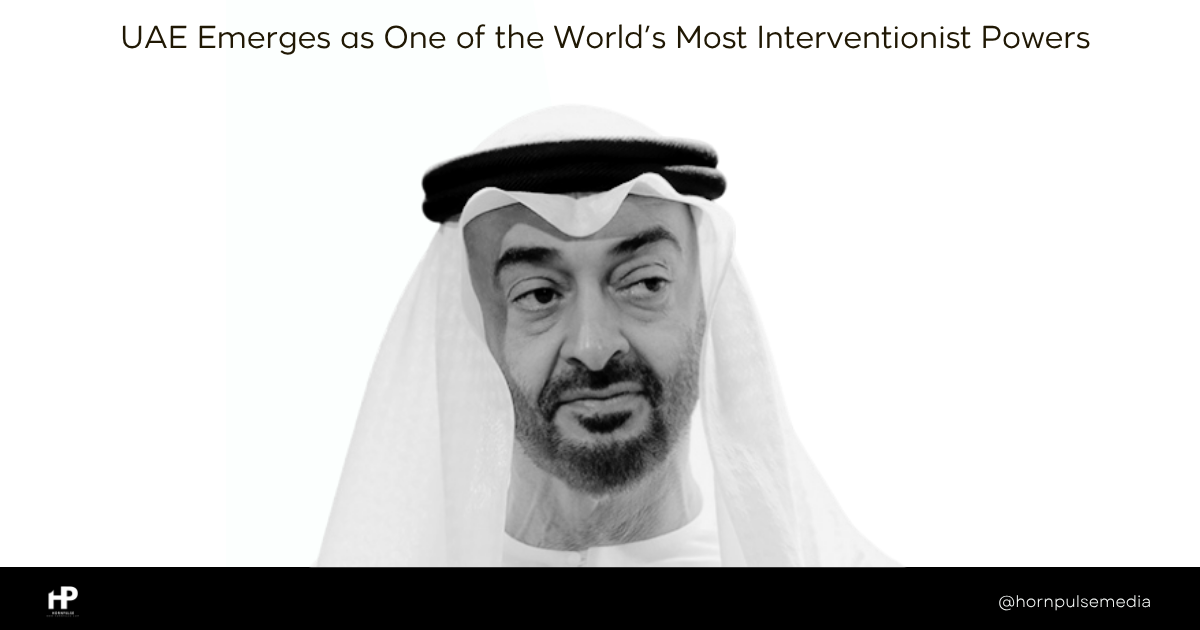
The United Arab Emirates (UAE) has undergone a dramatic military and geopolitical transformation over the past decade, evolving into one of the most interventionist states on the global stage. No other medium-sized nation has pursued such an extensive and assertive foreign policy, with nearly one external military engagement per year since 2015.
Driven by ambitions to shape regional order and counter perceived threats, Abu Dhabi has invested hundreds of millions of dollars not only in direct military operations but also in expanding its defense-industrial capacity — most notably through the EDGE Group, now one of the largest arms manufacturers in the Middle East.
A Decade of Expanding Military Footprint
The UAE’s international interventions span the Middle East, the Horn of Africa, and parts of the Sahel. These operations involve troop deployments, funding of local factions, mercenary forces, drone warfare, and the establishment of overseas military bases.
Yemen (2015–2025)
As part of the Saudi-led coalition, the UAE deployed up to 6,000 troops at the peak of its involvement. Although Abu Dhabi withdrew most forces in 2019, roughly 1,000 servicemen remain engaged in naval operations against Houthi forces. Emirati infrastructure in Aden, Socotra, and Perim continues to support 120 logistical flights annually.
Sudan (2023–2025)
The UAE has played a significant role in Sudan’s ongoing civil conflict, providing an estimated $1 billion in arms, 20 drones, and 500 mercenaries — including foreign contractors from Colombia. At least 50 cargo flights have passed through Chad to equip the Rapid Support Forces (RSF), supplying as many as 20,000 fighters.
Libya (2014–2020)
During Libya’s civil war, the UAE became one of the primary backers of General Khalifa Haftar, deploying 2,000 mercenaries and 20 drones. The country carried out roughly 300 airstrikes and invested around $500 million in munitions. Activity slowed only after the 2020 ceasefire.
Eritrea (2015–2021)
Abu Dhabi leased a base in Assab for $1 billion to support operations in Yemen and the Tigray conflict, stationing 2,000 troops and 10 naval vessels. Although the facility was partially shut down in 2021, it marked one of the UAE’s largest overseas ventures.
Somalia & Somaliland/Puntland (2012–2025)
The UAE maintains three bases — in Berbera, Bosaso, and Kismayo — with around 1,200 personnel involved in training 10,000 local fighters against Al-Shabaab. Equipment worth $400 million was delivered in 2024 alone, alongside 20 logistical flights.
Ethiopia (2020–2022)
During the Tigray conflict, the UAE supplied Ethiopia with $300 million in weapons, including drones, and conducted 120 cargo flights. Emirati advisors also trained 5,000 members of the Prime Minister’s Guard, with up to 1,000 advisors present at the height of the war.
Chad (2021–2025)
A base in Amdjarass hosts 400 Emirati troops and five aircraft. Roughly $200 million in equipment supports Sahel counterterrorism forces, while the base serves as a staging point for missions into Sudan.
Mozambique (2021–2023)
The UAE financed mercenary deployments and provided $100 million in helicopters and air support operations against insurgents in Cabo Delgado. Activity decreased after regional forces intervened.
Gaza (2023–2025, indirect involvement)
Reports indicate that the UAE facilitated intelligence and logistical support for Israel through contracted mercenaries, mainly from Yemen and Sudan. Funding is estimated at $50 million, with additional drone support. Activity increased in 2024 with the deployment of 200 African contractors.
A Strategy That Shows No Sign of Slowing
With around 10 military bases abroad and nearly 5,000 troops stationed outside its borders, the UAE now resembles regional powers of past decades that aggressively shaped conflicts beyond their borders.
The expansion of EDGE Group — acquiring stakes in global defense firms — sends a clear message: Abu Dhabi’s militarized foreign policy is not temporary. Instead, it appears to be a long-term strategy aimed at securing influence, countering rivals, and projecting power far beyond the Gulf.

