Sudan Appoints Pro-Democracy Leader Amgad Eltayeb as Foreign Policy Advisor
March 17, 2026
Somalia declares South West State’s leadership mandate expired amid rising tensions
March 23, 2026Hijacking Democracy: How Laftagareen’s Personal Ambition Collided with the Somali People’s Will
As Somalia enters one of the most critical crossroads in its history, the country has crossed a vital threshold toward democratization via the “one-person, one-vote” system. This reform, ratified by the Federal Parliament in Mogadishu, has finally opened the doors for elections based directly on the will of the people.
However, this historic transformation has been overshadowed by the abrupt and aggressive defiance of South West State leader, Abdiaziz Laftagareen. While Laftagareen moved to sever ties with Mogadishu, field developments and mounting public backlash suggest his gamble has backfired.
The JSP Breakaway: A Political “U-Turn”
It has come to light that Laftagareen was once one of the most vocal advocates for the very reforms he now opposes. As a co-founder and Vice Chairman of the JSP (Justice and Solidarity Party ) alongside President Hassan Sheikh Mohamud, Laftagareen spent years campaigning for a complete overhaul of the electoral system.
Local reports indicate the narrative changed only when the reality on the ground shifted. Once it became clear that Laftagareen would suffer a crushing defeat in a transparent, direct election, his political ideology underwent a sudden fracture. His resignation from the JSP and his subsequent anti-reform stance are now being labeled as “one of the most cynical reversals in Somali political history.”

The Streets Have Spoken: “We Stand with Hassan Sheikh Mohamud”
- “We stand with Hassan Sheikh Mohamud”
- “No to Dictatorship”
- “We Demand Our Right to Vote”
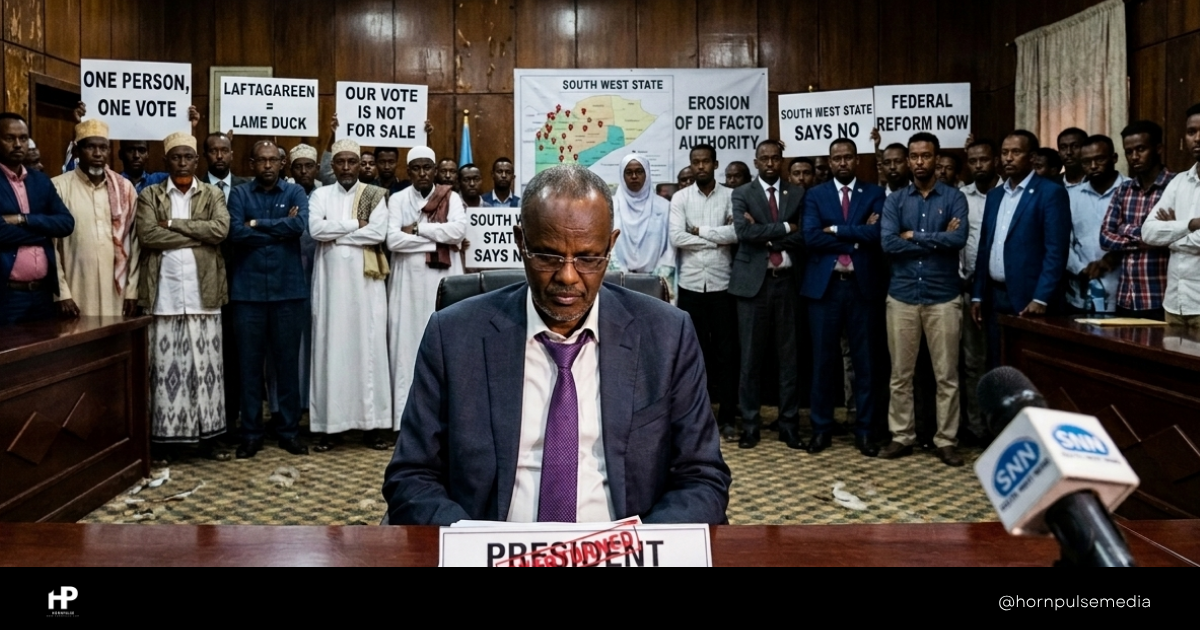
Laftagareen’s attempt to decouple from Mogadishu failed to find the grassroots resonance he anticipated. Instead, a wave of massive protests erupted across South West State. In strategic hubs such as the capital Barawe, Waajid, Buurhakaba, Qansaxdhere, Diinsoor, and Hudur, thousands took to the streets with clear demands:
Protesters explicitly rejected the obsolete system of hand-picked representatives decided behind closed doors, demanding direct participation in the democratic process.


Not Even a “Lame Duck”
The latest escalations in South West State confirm that this is more than just a paper crisis; it is the moment Abdiaziz Laftagareen’s dictatorial ambitions shattered against the wall of public defiance. Having lost all remaining legitimacy and retreating to the confines of his palace, Laftagareen has plummeted past the status of a “lame duck”—he is now a leader without a mandate.
The Total Erosion of Functional Authority
Information from local sources confirms that Laftagareen’s control over the state has not merely weakened; it has evaporated.
- Defiance of Orders: Local administrators and traditional elders in strategic centers have openly defied instructions from Baidoa, declaring their unwavering loyalty to the Federal Government.
- A Shrinking Domain: Political analysts highlight a stark reality: Laftagareen’s authority no longer extends beyond the municipal limits of Baidoa. With functional control lost in 90% of the state, his leadership has been replaced by a terminal administrative vacuum.
Behind the Crisis: Controversial Demands
Leaks from political circles suggest the “constitutional crisis” narrative is a smokescreen for failed blackmail. It is alleged that Laftagareen’s break with the capital followed Mogadishu’s refusal to grant his scandalous personal demands:
Direct and Unmonitored Funds: Access to vast resources from the central budget without federal oversight.
Diplomatic Usurpation: The power to appoint foreign envoys and manage external relations independently.
Feudal Autonomy: The shifting of federal powers to his regional level to bypass national law.
Harsh Rejection from Clan Leaders
The traditional power dynamics of the region have also shifted against him. Influential Ugas and Sultans, along with prominent local politicians, have largely withdrawn their support. These traditional leaders have condemned Laftagareen’s actions as a reckless attempt to plunge the state into instability simply to preserve his seat.
Somalia is witnessing a defining moment. On one side stands the march toward direct democracy; on the other, a desperate attempt to cling to an elitist status quo. While Laftagareen’s maneuvers have triggered a short-term crisis, the overwhelming public outcry proves that the era of “buying” power is over, and a new chapter for Somalia has begun.