

OYAK Partnership to Unlock Somalia’s Marine Potential
December 19, 2025
Which Somaliland Did Israel Recognize? Recognition Without Territory
December 26, 2025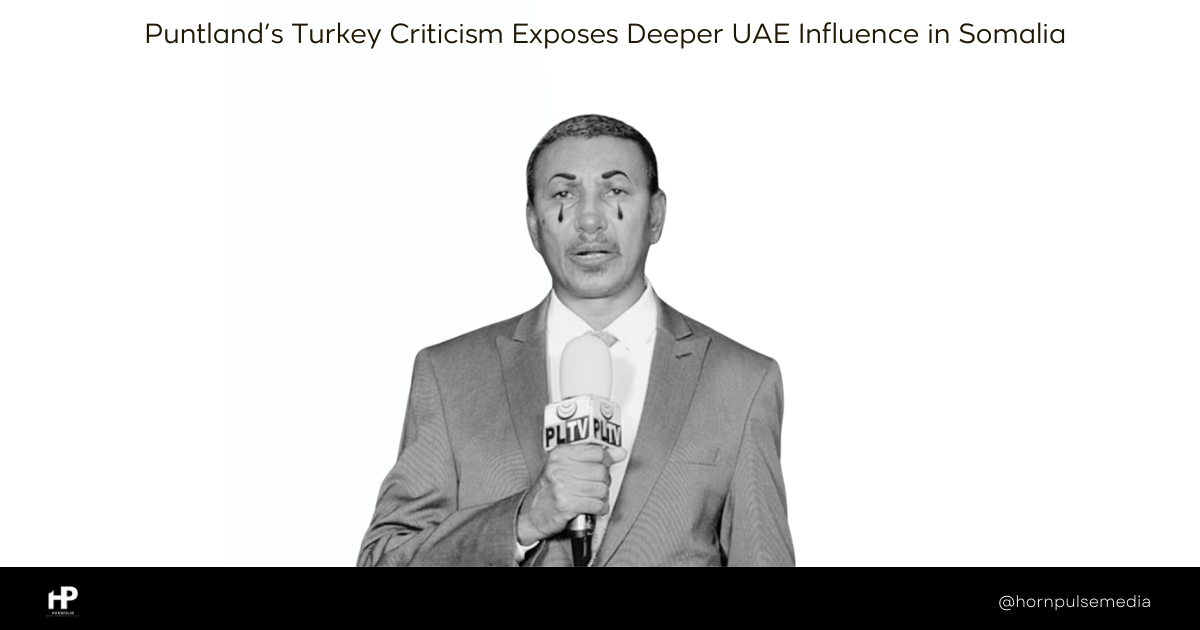
The sharp criticism directed at Turkey by Puntland’s Minister of Information, Mohamud Aided Dirir, has once again brought to the surface deeper contradictions within Somali politics. Dirir accused Turkey of failing to contribute to long-term stability, security, and good governance in Somalia, claiming instead that Ankara acts out of self-interest. However, when viewed in the context of Puntland’s long-standing and controversial relationship with the United Arab Emirates (UAE), these remarks raise serious questions about credibility and political consistency.
According to critics, Puntland’s leadership—particularly under President Said Abdullahi Deni—has increasingly opened the region to UAE political and military influence. This relationship has gone far beyond economic investments or port agreements, extending into security cooperation, military logistics, and regional conflicts. Observers argue that Puntland has effectively fallen into Abu Dhabi’s sphere of influence, with some even describing it as a de facto Emirati outpost in the Horn of Africa.
Puntland’s name has frequently surfaced in discussions surrounding the war in Sudan. Regional analysts and international media reports have suggested that the UAE has used Puntland as a logistical hub and transit point in its alleged support for Sudan’s Rapid Support Forces (RSF), a militia accused of mass atrocities that have killed thousands of civilians. These claims, while denied by the UAE, continue to fuel controversy over Puntland’s role in the wider regional conflict.
Another major criticism aimed at the Puntland administration involves allegations of corruption and bribery. Opposition figures and civil society voices have argued that financial flows from the UAE have influenced political decision-making in Puntland. According to these critics, material incentives provided to senior officials have weakened Puntland’s sovereignty and opened the door for foreign actors to gain access to ports, security infrastructure, and strategic territory. Puntland authorities have consistently rejected these accusations.
Against this backdrop, Puntland officials’ accusations that Turkey undermines Somalia’s sovereignty appear deeply ironic. Turkey’s presence in Somalia has largely operated through formal agreements with the federal government in Mogadishu and has focused on military training, humanitarian assistance, infrastructure development, and institutional capacity-building. By contrast, critics argue that Puntland’s engagement with the UAE has often lacked transparency and bypassed both federal oversight and public accountability.
Ultimately, Dirir’s remarks do more than criticize Turkey; they expose unresolved questions about Puntland’s own external alignments and political independence. For many Somalis, the debate is not about choosing between foreign partners, but about consistency, transparency, and sovereignty. Condemning one external actor while remaining silent about another’s deep and controversial influence risks undermining the credibility of Puntland’s leadership—and highlights the need for a more honest national conversation about foreign power, accountability, and Somalia’s future.

